To calculate your grade, multiply each score by its weight in the syllabus, add those results and divide by the total weight of the work graded so far. To find what you need on the final exam, take the points you still need for your target and divide them by the final's weight. Both steps are worked through below with one student's numbers.
Key takeaways
- Weighted grade = Σ(score × weight) ÷ Σ(weights graded so far).
- Needed on the final = (target × total weight − points so far) ÷ final weight.
- A plain average of your scores is usually wrong, because categories carry different weights.
- With a final worth 30%, every 10 marks on the final move the course grade by 3 points.
- Do not round until the last step. Rounding early can change the answer.
Your scores are easy to find: they are in the gradebook. Your grade is harder, because it depends on a weighting table somewhere in the syllabus, and the night before a final is a bad time to work it out by hand. So here is the method, with one example carried all the way through.
How do you calculate a weighted grade?
Multiply each score by its weight as a decimal, add the results to get your points, and divide by the total weight graded so far. With homework 95 (20%), quizzes 88 (10%), midterm 82 (25%) and a project 90 (15%), you have 61.8 points from 70% of the course: 61.8 ÷ 0.70 = 88.29%.
Here is the same calculation as a table. The weights come from the syllabus, the scores from the gradebook.
| Category | Score | Weight | Points (score × weight) |
|---|---|---|---|
| Homework | 95% | 20% | 95 × 0.20 = 19.0 |
| Quizzes | 88% | 10% | 88 × 0.10 = 8.8 |
| Midterm | 82% | 25% | 82 × 0.25 = 20.5 |
| Project | 90% | 15% | 90 × 0.15 = 13.5 |
| Graded so far | 70% | 61.8 |
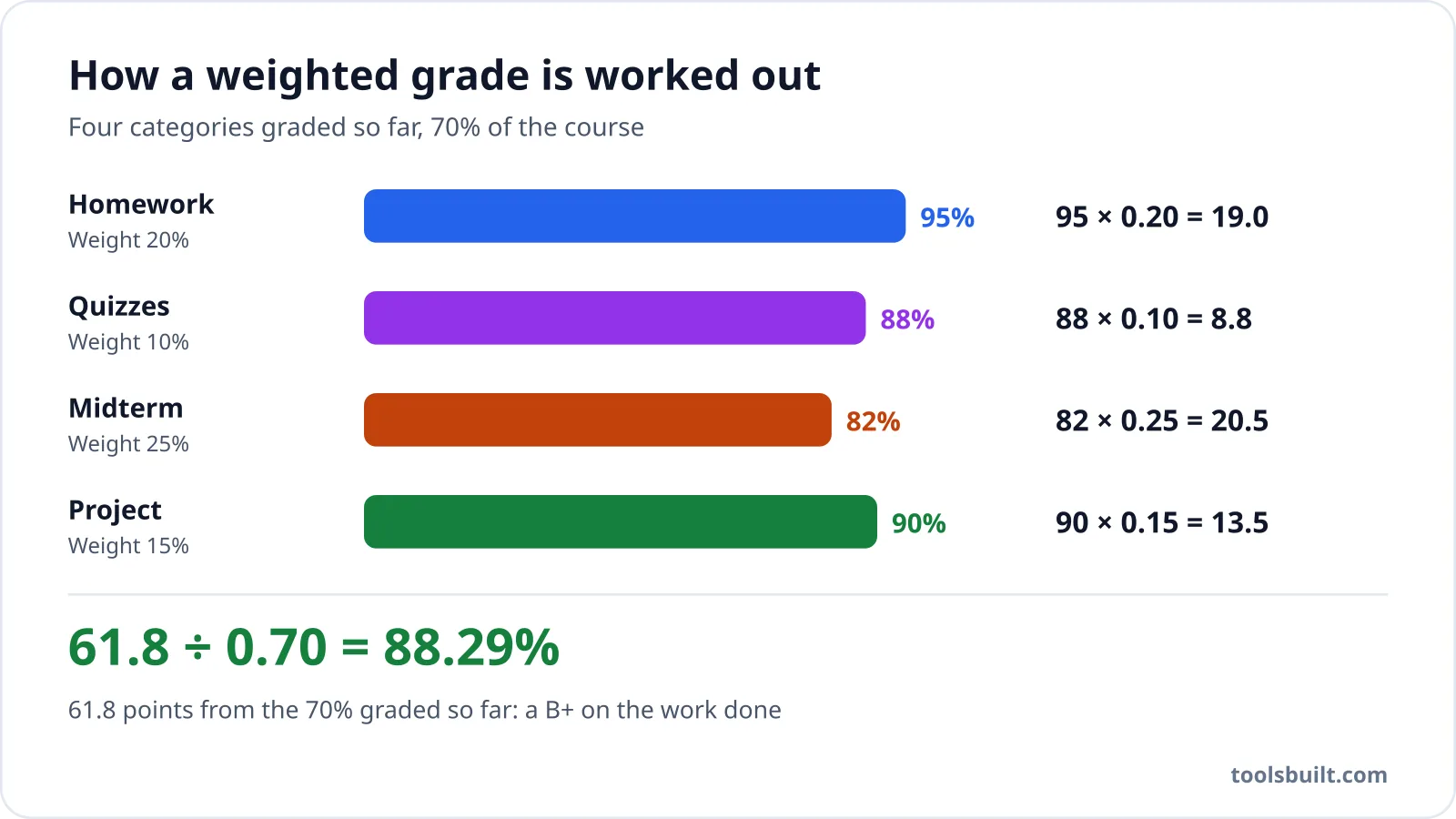
The last step is the one people skip. The final exam has not happened yet, so only 70% of the course has been graded. Dividing 61.8 by 0.70 gives your grade on the work done so far: 88.29%, a B+ on the scale our calculator uses. If the category has several items, such as four quizzes out of 25 marks each, add those marks first: 22 + 21 + 23 + 22 = 88 out of 100, which is the 88% in the table.
The grade calculator does exactly this: type each category's score and weight and it shows the points and the grade.
Why is my grade not the average of my scores?
A plain average gives every score the same importance, but a syllabus does not. A 100 on homework worth 10% and a 65 on a midterm worth 40% average to 82.5%, a B-. The weighted grade is (100 × 0.10 + 65 × 0.40) ÷ 0.50 = 72%, a C-, because the midterm counts four times as much.
In the main example the two methods are close: the plain average of 95, 88, 82 and 90 is 88.75%, against the weighted 88.29%. They are close only because the scores are close. The further apart your scores are, and the more uneven the weights, the bigger the gap. A low score in a heavy category drags the grade down far more than the average suggests.
What is the difference between weighted grades and total points?
In a total-points course every assignment is worth a number of points, and your grade is points earned ÷ points possible. In a weighted course each category is worth a percentage of the grade. A 45/50 quiz and a 160/200 test give 205 ÷ 250 = 82% on points, not the 85% you get by averaging 90% and 80%.
The bigger test counts for more because it has more points. If your syllabus lists points rather than percentages, add up the points and divide. The same mistake shows up with exam marks, which is explained in the guide to percentage formulas. If your teacher weights items by hand, the weighted average calculator takes any values with any weights.
How do you calculate what you need on the final exam?
Needed on the final = (target × total weight − points so far) ÷ final weight. Our student has 61.8 points, the final is worth 30% and the target is 90%. The course totals 100%, so the target is 90 points: (90 − 61.8) ÷ 0.30 = 28.2 ÷ 0.30 = 94% on the final.
Change the target and the answer changes a lot:
| Target course grade | Points needed from the final | Score needed on the final |
|---|---|---|
| 90% (A-) | 28.2 | 94% |
| 87% (B+) | 25.2 | 84% |
| 80% (B-) | 18.2 | 60.67% |
| 70% (C-) | 8.2 | 27.33% |
| 60% (D-) | already reached | any score, even 0% |
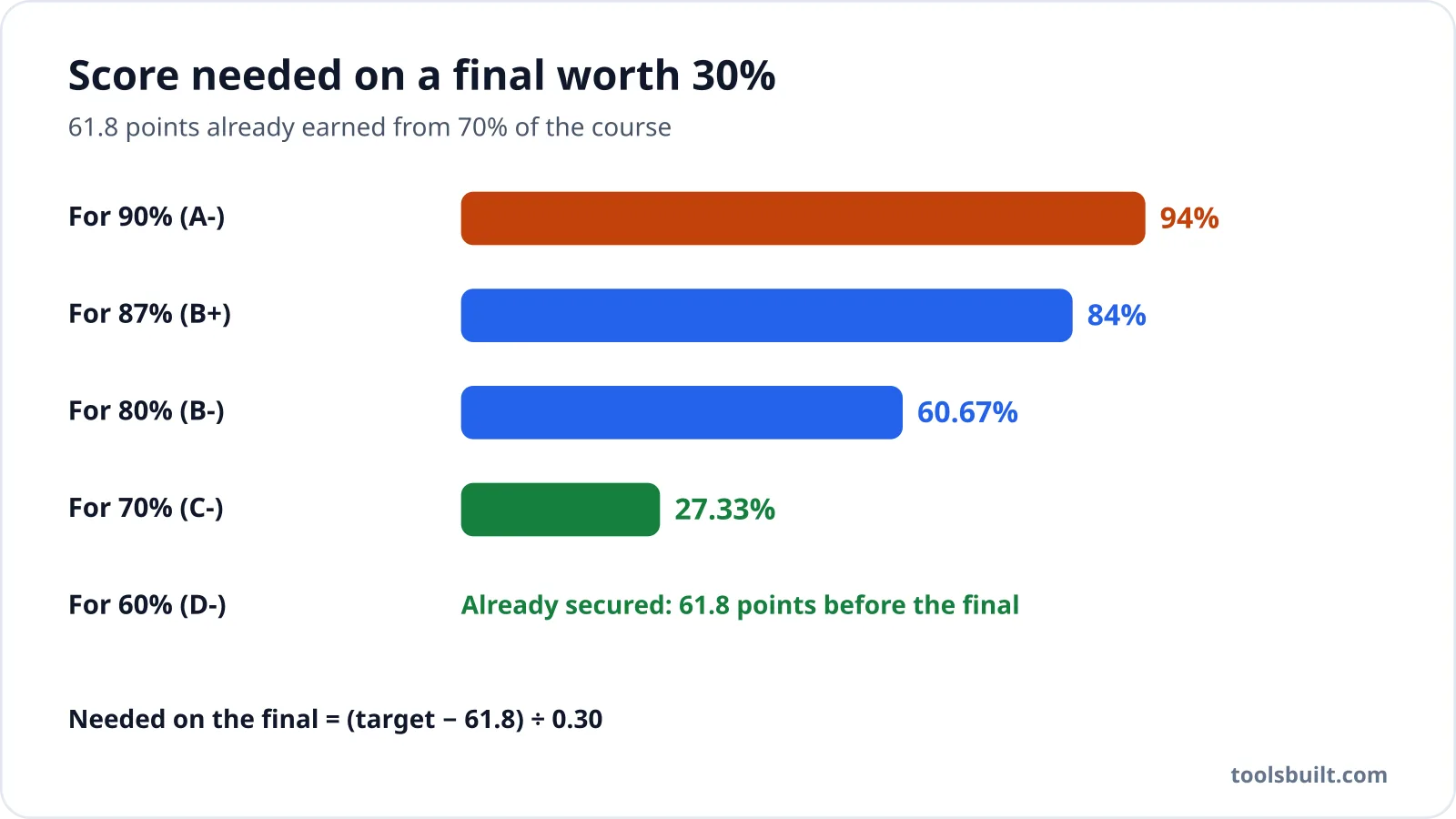
Two results need a word. If the needed score is above 100%, the target cannot be reached from the final alone, unless there is extra credit. If it is zero or below, you already have that grade: our student's 61.8 points are above 60 before the final starts.
What will my grade be if I score a certain mark on the final?
Course grade = points so far + final score × final weight. With 61.8 points and a final worth 30%, an 80 on the final gives 61.8 + 80 × 0.30 = 85.8%, a B. Because the final is worth 30%, every 10 marks on it move the course grade by exactly 3 points.
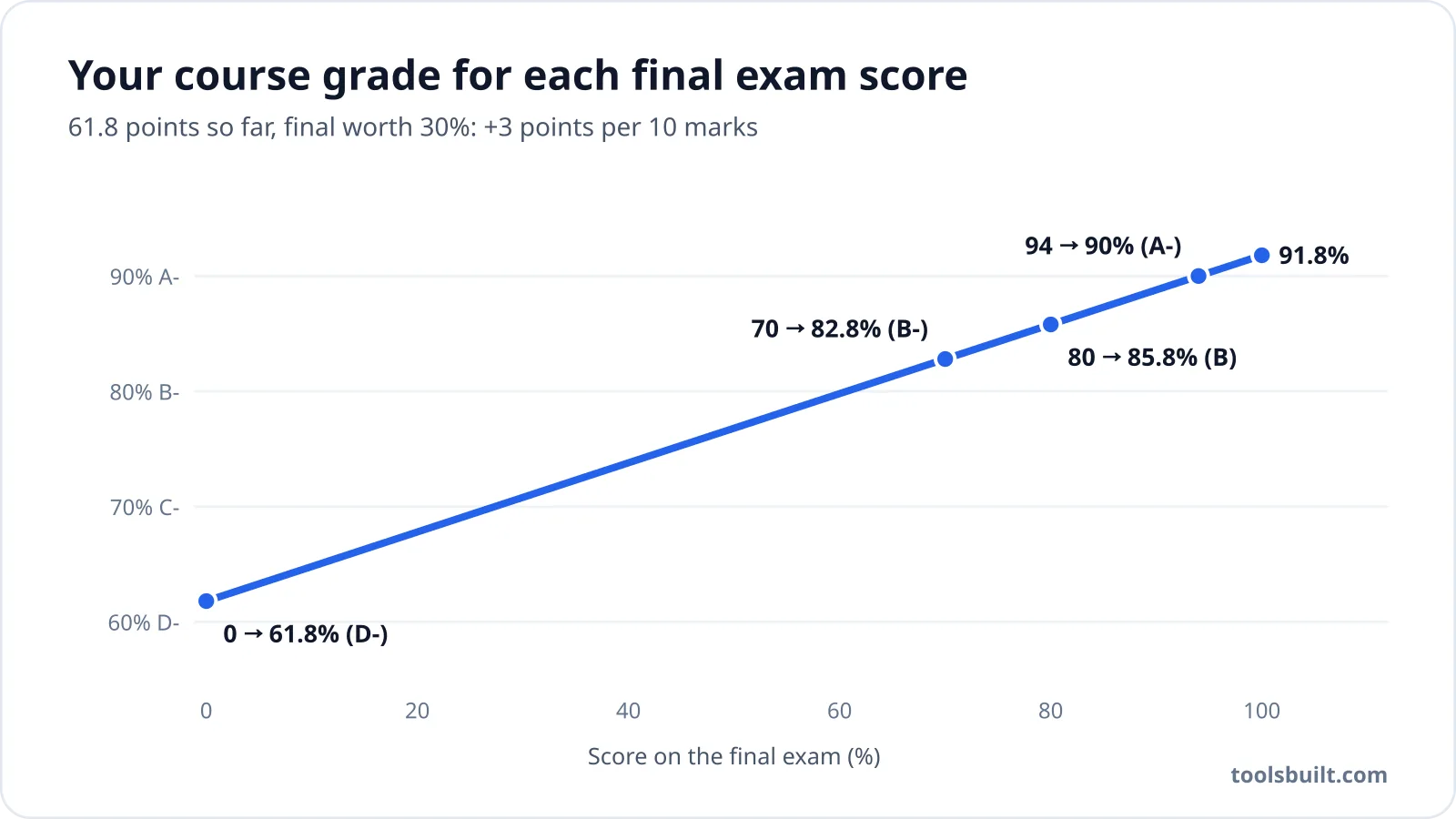
This is the "what if" view, and it is useful for planning revision. Our student can finish anywhere between 61.8% (a 0 on the final) and 91.8% (a perfect final). A 70 gives 82.8%, a B-. Moving from a 70 to an 80 on the final is worth 3 points on the course grade, which here is the difference between a B- and a B.
The steepness depends only on the final's weight. If the final were worth 50%, every 10 marks would move the grade by 5 points. That is why the final matters so much more in some courses than in others.
Which letter grade is my percentage?
It depends on your school, so check the syllabus first. A common US scale, the one our grade calculator uses, is: A 93–96, A- 90–92, B+ 87–89, B 83–86, B- 80–82, C+ 77–79, C 73–76, C- 70–72, D+ 67–69, D 63–66, D- 60–62 and F below 60. A score of 97 or more is shown as A+.
| Percentage | Letter | Percentage | Letter |
|---|---|---|---|
| 97 and above | A+ | 77–79 | C+ |
| 93–96 | A | 73–76 | C |
| 90–92 | A- | 70–72 | C- |
| 87–89 | B+ | 67–69 | D+ |
| 83–86 | B | 63–66 | D |
| 80–82 | B- | 60–62 | D- |
| Below 60 | F |
Many schools drop the plus and minus and use plain 90/80/70/60 cut-offs, and some round 89.5 up to 90 while others do not. To turn letter grades into a grade point average across several courses, use the GPA calculator.
What mistakes give a wrong grade?
Four mistakes cause most wrong answers: averaging scores instead of weighting them, dividing by 100% before the course is finished, using the wrong weight for the final, and rounding too early. Each one can move the result by a whole letter grade or by a fraction of a point at the worst moment.
- Averaging instead of weighting. As shown above, 100 and 65 average to 82.5%, but with weights of 10% and 40% the grade is 72%.
- Dividing by the whole course too soon. Our student's 61.8 points are not a grade of 61.8%. Only 70% of the course is graded, so the grade is 61.8 ÷ 0.70 = 88.29%. Dividing by 1.00 turns a B+ into a D-.
- Using the wrong final weight. Some syllabi let the final replace the lowest test score, or split it into a written and a practical part. Use the weight that will actually apply.
- Rounding too early. I found this one in our own calculator while writing this guide. It rounded the current grade to 88.29% before working out the final, and got 93.99% instead of 94%. The exact figure is (90 − 61.8) ÷ 0.30 = 94. Keep full numbers until the last step. The calculator now does.
How can you check your grade quickly?
Open the grade calculator, enter each category's score and weight, then your target grade and the final's weight. It shows your current grade, the letter, and the score you need on the final, with the formula written out so you can check it against this guide.
Your numbers stay in your browser, and there is no sign-up. If your school grades by total points instead of weights, enter each item's percentage with its share of the total points as the weight, or simply add the points and divide.
One last thing: the grade in the official gradebook is the one that counts. If your calculation and the portal disagree, ask your teacher how they weight the categories. It is a fair question, and the answer usually explains the gap.
— Abu Umair