Your monthly installment (EMI) comes from one formula: EMI = P × r × (1 + r)ⁿ ÷ ((1 + r)ⁿ − 1), where P is the amount you borrow, r is the yearly interest rate divided by 1,200, and n is the number of months. Borrow Rs 1,500,000 at 20% a year for 3 years and you pay Rs 55,745.38 a month. You can check any quote in seconds with our loan EMI calculator, but it pays to understand what the number hides.
Key takeaways
- EMI depends on three numbers: the amount, the rate and the number of months. Change any one and the total cost moves a lot.
- Early installments are mostly interest. On a 15-year home loan at 16%, principal only overtakes interest in month 129.
- A "flat" rate is far more expensive than the same number quoted as "reducing balance". 20% flat works out to about 33.6% reducing.
- Extra payments save the most when you keep the EMI the same and let the loan finish sooner.
- If your loan has a floating rate linked to KIBOR, the EMI can change at each repricing date. Your loan agreement says which kind you have.
The rates in this guide are examples chosen to make the arithmetic easy to follow. They are not offers. Your bank's rate depends on KIBOR, its own margin and your profile, so ask for the current figure before you sign anything.
What is the formula for calculating EMI?
EMI is calculated with the reducing-balance annuity formula: EMI = P × r × (1 + r)ⁿ ÷ ((1 + r)ⁿ − 1). P is the loan amount, r is the monthly rate as a decimal (annual rate ÷ 1,200) and n is the number of monthly payments. Every installment is the same, but its interest share shrinks over time.
Let's run it on a loan size that could pay for a bike, a used small car or a family expense: Rs 1,500,000, repaid over 3 years at an example rate of 20%.
- Monthly rate: r = 20 ÷ 1,200 = 0.016667 (that is 1.6667% a month, not 20%).
- Number of payments: n = 3 × 12 = 36.
- Growth factor: (1 + r)ⁿ = 1.016667³⁶ = 1.8131.
- EMI: 1,500,000 × 0.016667 × 1.8131 ÷ (1.8131 − 1) = Rs 55,745.38.
- Total paid: 36 installments come to Rs 2,006,833.48, so the interest is Rs 506,833.48.
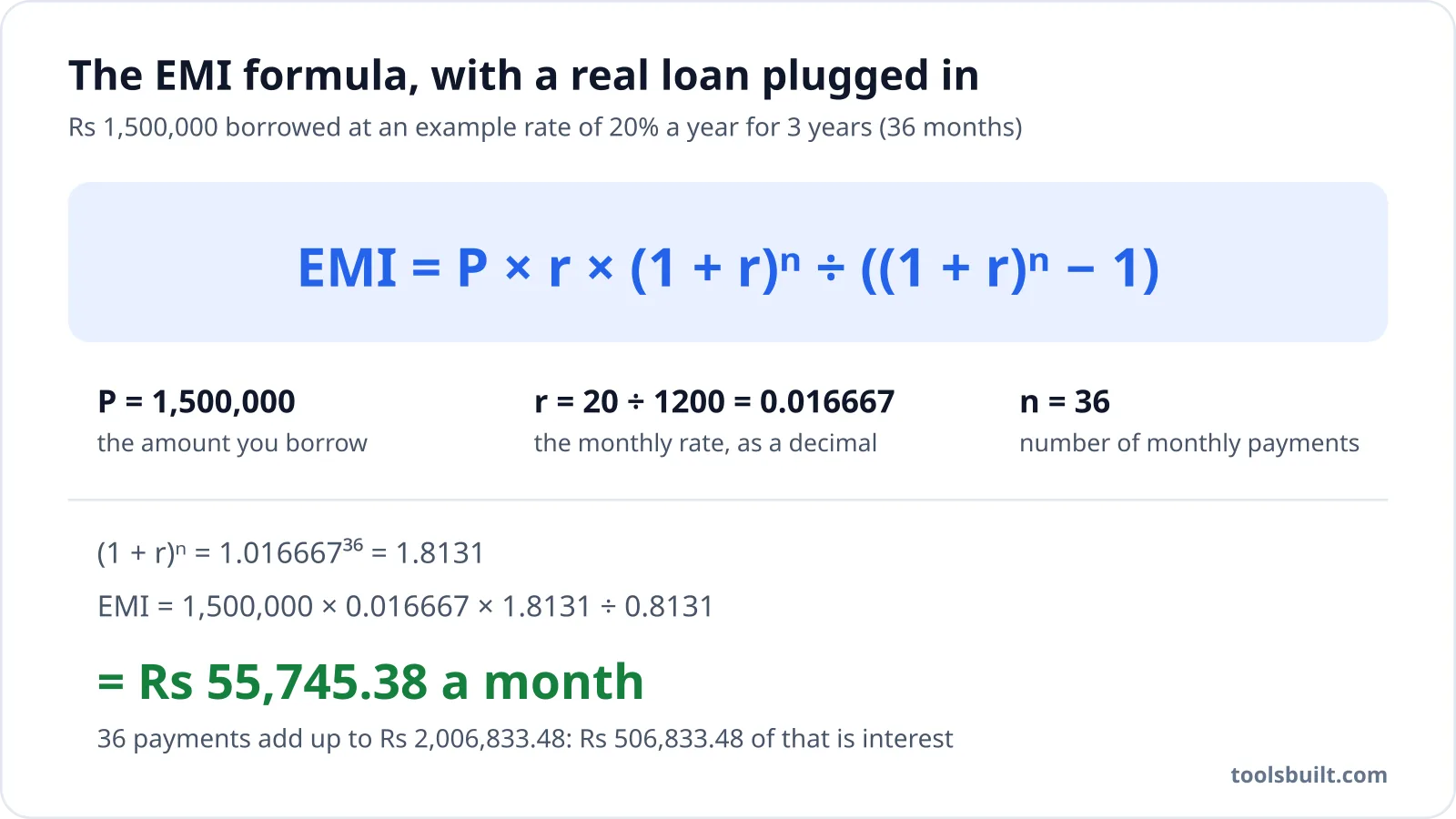
Why is the total not exactly 36 × 55,745.38? The last installment is adjusted so the balance lands on zero. Here it is Rs 55,745.18, twenty paisa less than the others. Bank schedules do the same thing, so do not be surprised by a slightly different final payment.
You can open this exact loan in the calculator and see all 36 rows of the schedule.
How much of my EMI goes to interest?
At the start, most of it. Interest each month is the outstanding balance × the monthly rate, so when you owe the most you pay the most interest. In month 1 of the Rs 1,500,000 loan, Rs 25,000.00 of the Rs 55,745.38 EMI is interest and only Rs 30,745.38 reduces what you owe.
Here is how the same loan looks year by year:
| Year | Interest paid | Principal repaid | Balance at year end |
|---|---|---|---|
| 1 | Rs 264,228.83 | Rs 404,715.73 | Rs 1,095,284.27 |
| 2 | Rs 175,437.82 | Rs 493,506.74 | Rs 601,777.53 |
| 3 | Rs 67,166.83 | Rs 601,777.53 | Rs 0.00 |
On a short loan the effect is mild. On a home loan it dominates. Take Rs 5,000,000 over 15 years at an example 16%. The EMI is Rs 73,435.04, and in the first month Rs 66,666.67 of it is interest. Only Rs 6,768.37 goes toward the house.
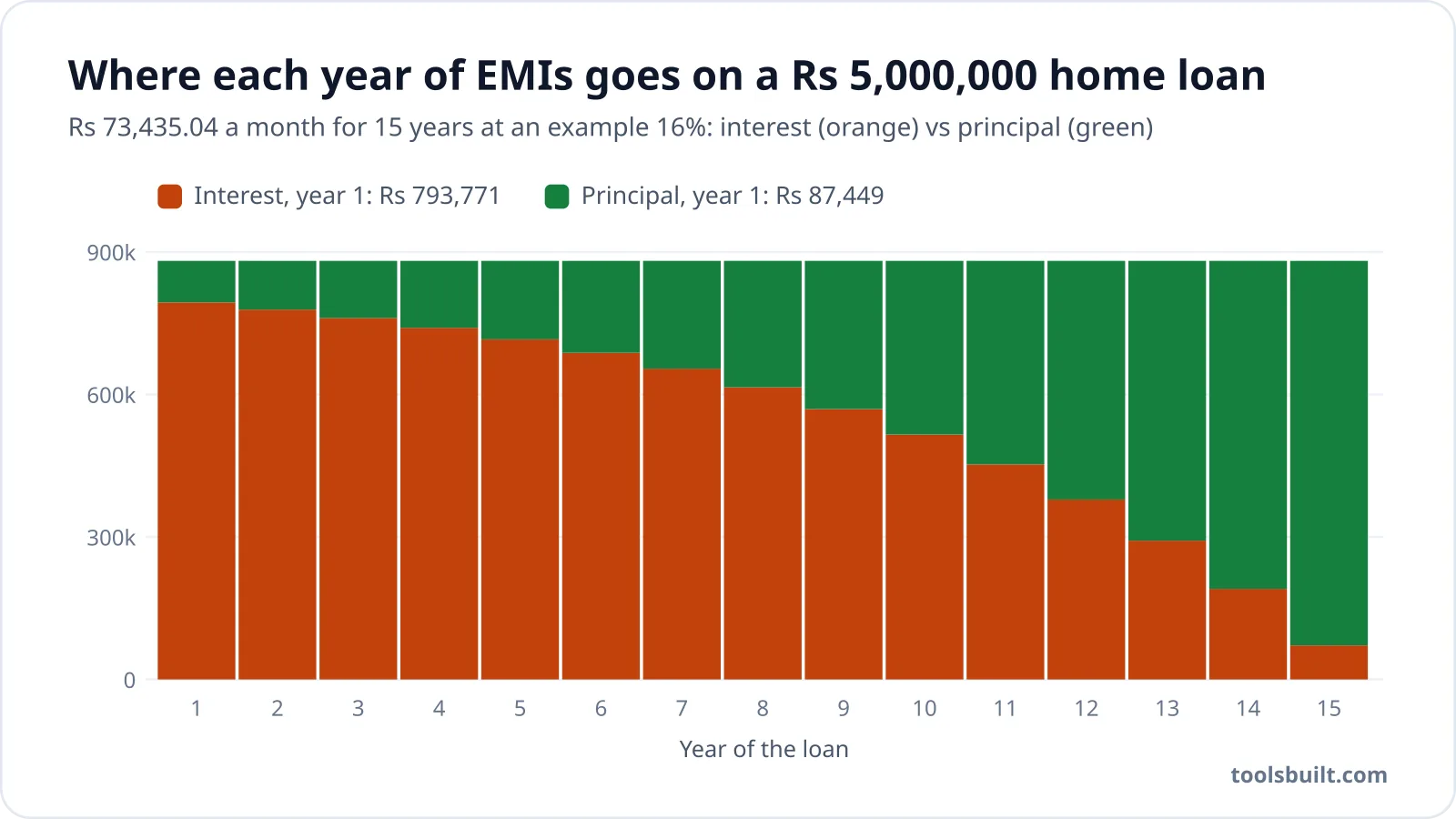
The principal part does not overtake the interest part until month 129, more than ten and a half years in. Over the whole loan you repay Rs 13,218,304.92, of which Rs 8,218,304.92 is interest. That is 62.2% of everything you hand the bank. Most people only look at the monthly payment, and that is the trap.
Does a longer tenure make a loan cheaper?
No. A longer tenure lowers each EMI but raises the total interest, because you owe money for longer. On Rs 1,500,000 at 20%, stretching the loan from 3 to 5 years cuts the EMI by about Rs 16,000 but adds Rs 377,615.86 of interest. Pick the shortest tenure whose EMI you can carry comfortably.
| Tenure | Monthly EMI | Total interest | Total repaid |
|---|---|---|---|
| 2 years (24 months) | Rs 76,343.70 | Rs 332,248.91 | Rs 1,832,248.91 |
| 3 years (36 months) | Rs 55,745.38 | Rs 506,833.48 | Rs 2,006,833.48 |
| 5 years (60 months) | Rs 39,740.83 | Rs 884,449.34 | Rs 2,384,449.34 |
The honest trade-off: a lower EMI gives you breathing room if your income is uneven, and that has real value. But if you choose 5 years for comfort, plan to pay it down faster when you can. The section on extra payments shows how much that is worth.
A useful sanity check before you apply is to compare the EMI with your take-home pay, not your gross salary. Our Pakistan salary tax calculator shows the monthly figure after income tax.
What happens to my EMI when KIBOR changes?
On a floating-rate loan linked to KIBOR, your rate is KIBOR plus the bank's margin, reset on the dates in your agreement. When KIBOR moves, the bank recalculates the EMI on the balance you still owe. If the rate on a Rs 5,000,000, 15-year loan rose from 16% to 18%, the EMI would go up by Rs 7,086.01 a month.
KIBOR (the Karachi Interbank Offered Rate) is published by the State Bank of Pakistan, and you can look up the current figures on SBP's KIBOR rates page. We are not quoting a number here on purpose: it changes, and your loan uses the KIBOR tenor and reset dates written in your own agreement.
To see how sensitive a long loan is, here is the same Rs 5,000,000 over 15 years at three example rates, as if each rate applied for the whole term:
| Example rate | Monthly EMI | Total interest over 15 years |
|---|---|---|
| 14% | Rs 66,587.07 | Rs 6,985,672.12 |
| 16% | Rs 73,435.04 | Rs 8,218,304.92 |
| 18% | Rs 80,521.05 | Rs 9,493,791.35 |
Two percentage points look small on paper. Over 15 years they are worth more than Rs 1.2 million in either direction. If your budget only works at today's rate, it is too tight.
One protection worth knowing: the State Bank's Prudential Regulations for Consumer Financing require banks to give you a detailed repayment schedule at the start. When it changes because of a prepayment or a change in the benchmark rate, they must send a revised schedule within 15 days (Part B, Operations, point 5). Ask for it, and check it against the calculator.
Should I pay extra, and should I lower my EMI or shorten the loan?
If your bank allows it at a reasonable cost, paying extra early is the most effective way to cut interest. Then ask the bank to keep your EMI unchanged so the loan ends sooner. Lowering the EMI instead feels nicer each month but saves much less.
Start with a small, regular top-up. Add Rs 10,000 a month to the Rs 73,435.04 EMI on the Rs 5,000,000 home loan and the loan is gone in 122 months instead of 180, almost five years early. Total interest drops from Rs 8,218,304.92 to Rs 5,107,685.05, a saving of Rs 3,110,619.87.
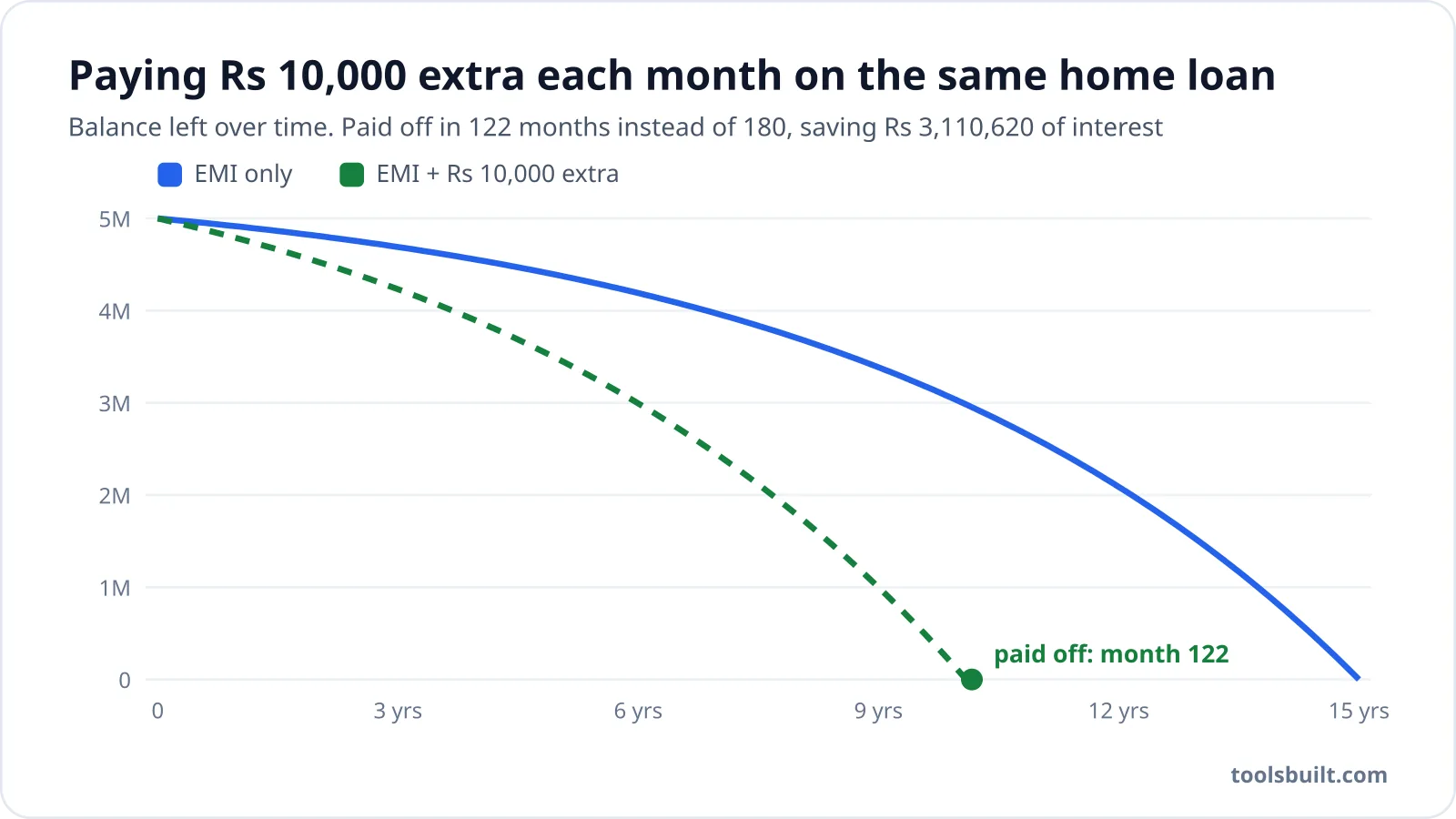
Try the Rs 10,000 extra payment yourself and change the amount to whatever you can manage.
Now a lump sum, say a bonus or the proceeds of selling a plot. Suppose you pay Rs 500,000 off the same loan after the 24th installment, when Rs 4,810,036.03 is still outstanding. Ask your bank which of these two outcomes it offers, because the difference is large:
| After the Rs 500,000 prepayment | Monthly EMI | Loan ends | Interest saved |
|---|---|---|---|
| Keep the EMI, shorten the loan | Rs 73,435.04 | Month 140 (40 months early) | Rs 2,496,230.41 |
| Keep the end date, reduce the EMI | Rs 65,801.51 | Month 180 | Rs 690,826.65 |
Same Rs 500,000, more than three times the saving. Choose the lower EMI only if the monthly relief is what you actually need.
Before you prepay, read the prepayment or early-settlement clause in your loan agreement. Charges and minimum amounts vary between banks and products, and a fee changes the maths. Islamic home and car financing is structured differently, for example as rent or profit rather than interest, so ask the bank for its own revised schedule rather than assuming the figures above apply line for line.
What are the most common EMI mistakes?
The costly ones are comparing a flat-rate quote with a reducing-balance quote, using the yearly rate as if it were monthly, and judging a loan by its EMI alone. Each can make a bad deal look fine. Here is each one with the numbers.
Mistake 1: treating a flat rate like a reducing-balance rate
If anyone quotes you a "flat" rate, slow down. A flat rate charges interest on the full original amount for the whole term, even after you have repaid most of it.
- Wrong: "20% flat sounds the same as 20% from the bank." Interest = 1,500,000 × 20% × 3 = Rs 900,000. EMI = (1,500,000 + 900,000) ÷ 36 = Rs 66,666.67.
- Right: compare it with 20% reducing balance: EMI Rs 55,745.38, total interest Rs 506,833.48.
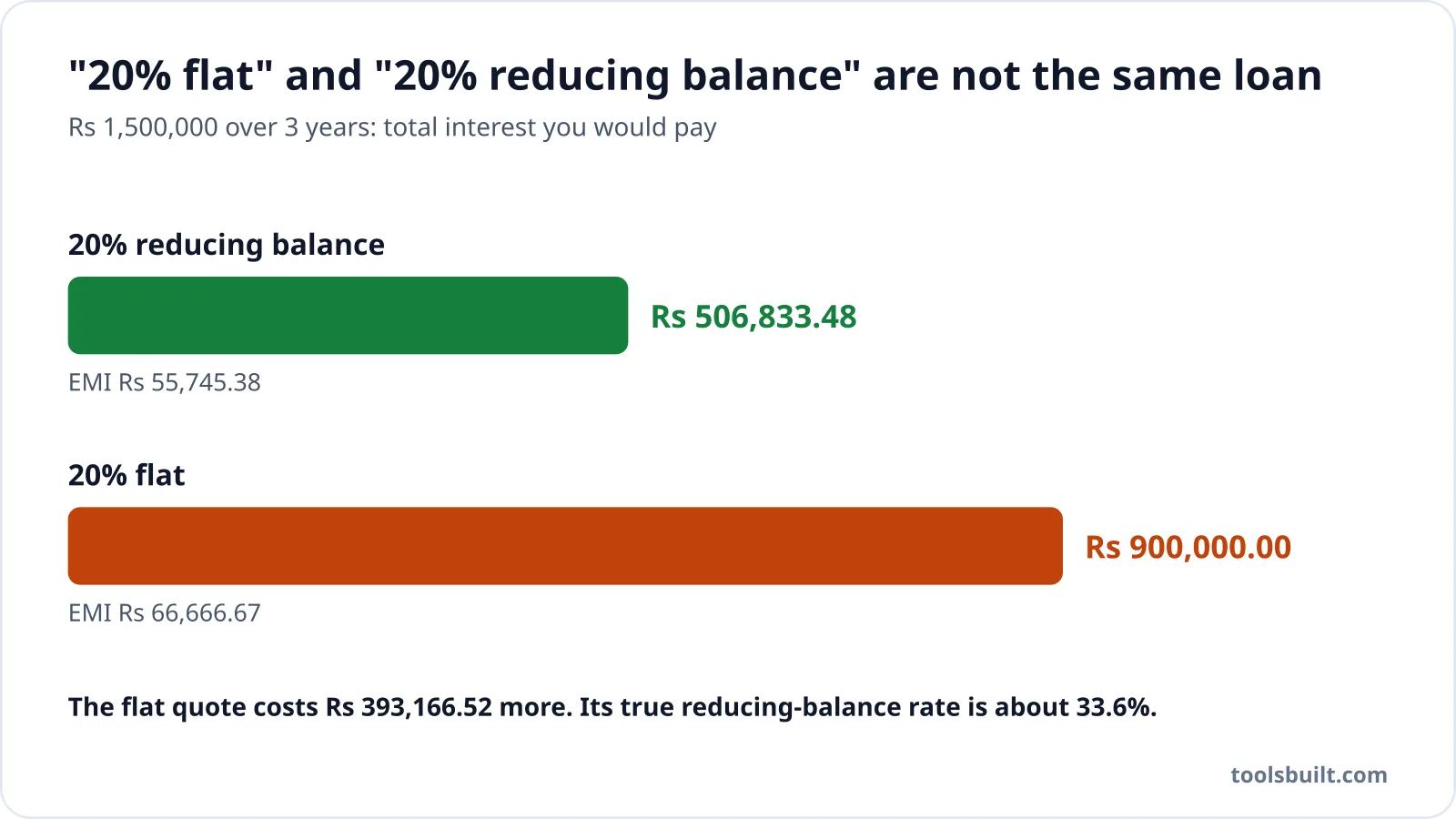
To compare fairly, work out the reducing-balance rate that produces the flat EMI. For Rs 66,666.67 a month over 36 months on Rs 1,500,000, that rate is about 33.6%. Ask every lender which method they use, in writing.
Mistake 2: using the yearly rate as the monthly rate
The formula needs the monthly rate. Plug in 0.20 instead of 0.016667 and the same Rs 1,500,000 loan shows an EMI of Rs 300,423.85, more than five times the right answer of Rs 55,745.38. A quick check catches this and smaller slips too: multiply the EMI by the number of months. Here that gives about Rs 10.8 million to repay Rs 1.5 million over three years, which no lender would offer. If the total looks wildly out of line with what you borrowed, recheck r first.
Mistake 3: picking a loan by its EMI
The 5-year option in the tenure table has the friendliest EMI, Rs 39,740.83. It also costs Rs 884,449.34 in interest, Rs 552,200.43 more than the 2-year option. Always look at total interest next to the EMI. Our calculator shows both side by side for that reason.
How do I check my bank's EMI quote?
Ask the bank for four things: the amount, the rate and whether it is fixed or floating, the tenure in months, and whether it is reducing balance. Enter them in the calculator. If your EMI differs by more than a few rupees, ask the bank what is included, such as insurance or fees.
- Open the loan EMI calculator. It starts in rupees.
- Enter the amount, the annual rate and the tenure. Pick months or years.
- Compare the EMI and total interest with the bank's figures, then download the schedule as a CSV if you want to check it row by row.
- Add an extra monthly amount to see how much sooner you could finish.
If the bank's figure is higher, the usual reasons are takaful or insurance rolled into the installment, processing fees added to the amount, or a different rounding convention. None of these is wrong in itself, but you should know which one it is.
Loans are mostly percentages under the hood. If you want a refresher on percentage increases, discounts and the "divide by the starting value" rule, read our guide to percentage formulas for marks, discounts and changes. More money tools, including the compound interest calculator for the savings side of the picture, are in the math and finance category.