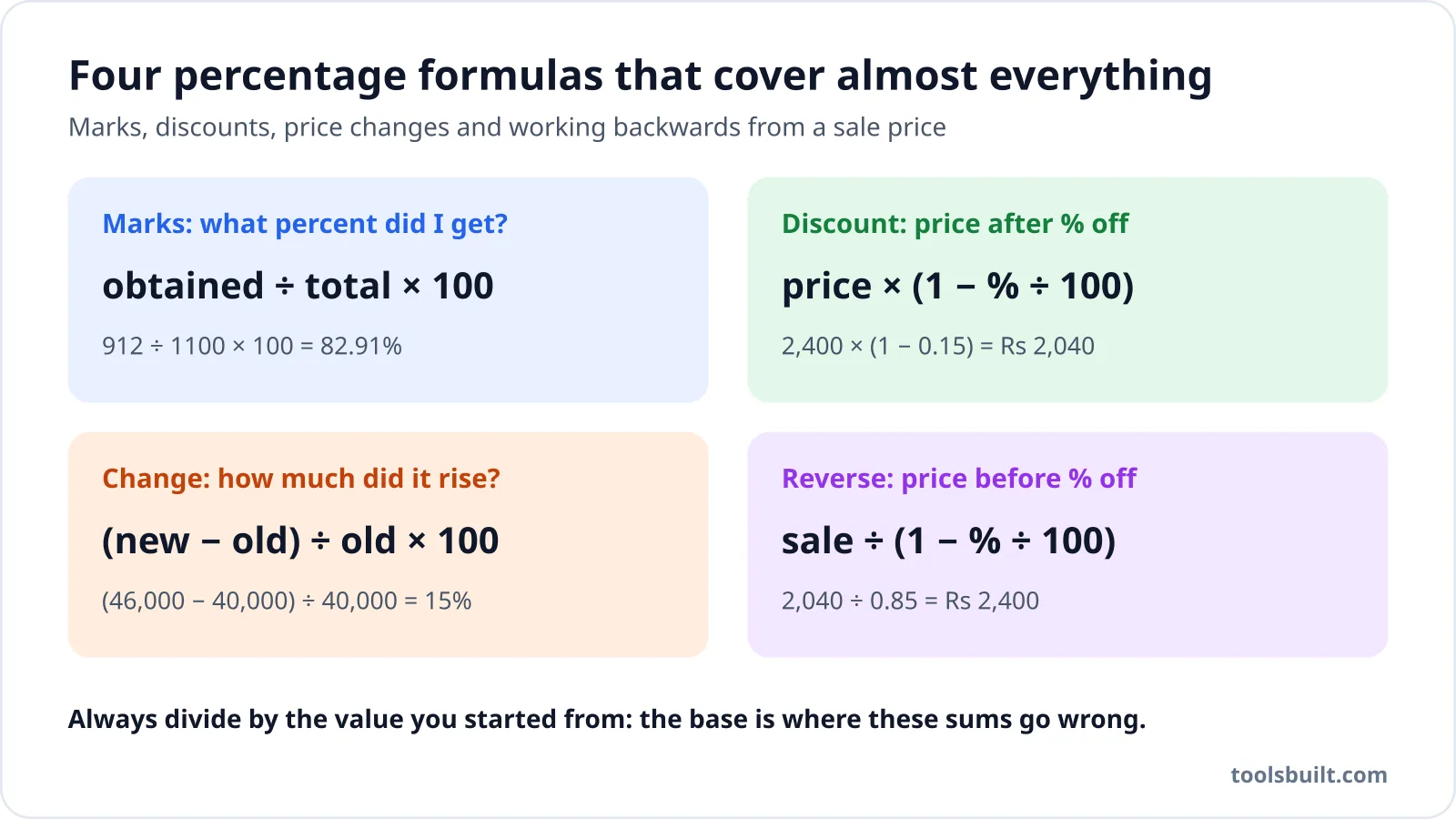
A percentage is a part divided by the whole, multiplied by 100. For exam marks that is obtained ÷ total × 100, for a discount the sale price is price × (1 − discount ÷ 100), and for a rise or fall it is (new − old) ÷ old × 100. The mistakes in this guide all come down to dividing by the wrong number, so it keeps asking one question: what did you start from?
Key takeaways
- Percentage = part ÷ whole × 100. The "whole" is always the starting value or the total available.
- To undo a discount, divide by (1 − discount). Adding the same percentage back gives the wrong price.
- Two discounts in a row do not add up: 20% then 10% is 28%, not 30%.
- A 15% rise is undone by a 13.04% fall, not a 15% fall.
- Never average percentages that have different totals. Add the marks first.
What is the basic percentage formula?
Percentage = (part ÷ whole) × 100. To find a percentage of a number, turn it the other way round: (percentage ÷ 100) × number. So 18 passes out of 24 students is 18 ÷ 24 × 100 = 75%, and 15% of Rs 2,400 is 0.15 × 2,400 = Rs 360.
Those two directions cover most everyday questions:
- "What percent is this?" Divide, then multiply by 100. 18 ÷ 24 = 0.75, and 0.75 × 100 = 75%.
- "How much is X% of this?" Turn the percentage into a decimal and multiply. 15% becomes 0.15, and 0.15 × 2,400 = 360.
A third question, "this is X% of what?", runs it backwards: number ÷ (percentage ÷ 100). If Rs 360 is 15% of something, that something is 360 ÷ 0.15 = Rs 2,400. Our percentage calculator has a mode for each of these, with the working shown.
| You want to know | Formula | Example |
|---|---|---|
| Your marks as a percentage | obtained ÷ total × 100 | 912 ÷ 1100 × 100 = 82.91% |
| X% of a number | X ÷ 100 × number | 15% of 2,400 = 360 |
| Price after a discount | price × (1 − X ÷ 100) | 2,400 × 0.85 = 2,040 |
| Discount percentage from two prices | (original − sale) ÷ original × 100 | (3,200 − 2,720) ÷ 3,200 = 15% |
| Price before a discount | sale ÷ (1 − X ÷ 100) | 2,040 ÷ 0.85 = 2,400 |
| Increase or decrease | (new − old) ÷ old × 100 | (46,000 − 40,000) ÷ 40,000 = 15% |
How do I calculate my percentage of marks?
Divide your obtained marks by the total marks and multiply by 100. If you scored 912 out of 1100 in matric, that is 912 ÷ 1100 = 0.82909, and × 100 = 82.91%. Use the total printed on your own result card, because totals vary between boards, groups and years.
Worked step by step:
- Obtained ÷ total: 912 ÷ 1100 = 0.829091.
- × 100 = 82.9091%.
- Round to two decimals: 82.91%.
For FSc or ICS results that come in two parts, add the parts before dividing. Say Part 1 was 465 out of 550 and Part 2 was 478 out of 550. Combined, that is 943 out of 1100, and 943 ÷ 1100 × 100 = 85.73%. On their own the parts are 84.55% and 86.91%. Here averaging those two happens to give the same 85.73%, but only because both parts carry the same 550 marks. The mistakes section shows what goes wrong when they don't.
The same formula works for a single subject. 68 out of 75 in maths is 68 ÷ 75 × 100 = 90.67%.
If you want the arithmetic done for you, with a typical BISE-style grade shown next to the result, enter your marks in the marks percentage calculator. For university admission aggregates, which weight matric, inter and entry test marks differently, use the separate merit calculator, because the weights come from each university's formula.
How do I calculate a discount and the sale price?
Multiply the price by (1 − discount ÷ 100). A shopkeeper giving 15% off a Rs 2,400 suit charges 2,400 × 0.85 = Rs 2,040, which is Rs 360 off. To find the discount percentage from two prices, divide the amount saved by the original price: (3,200 − 2,720) ÷ 3,200 × 100 = 15%.
Both directions come up at the counter.
Working out the sale price. 15% of 2,400 is 360. Take it off: 2,400 − 360 = Rs 2,040. Or in one step: 2,400 × 0.85 = 2,040. The one-step version is handy on a phone calculator, because 0.85 is simply "what is left after 15% off".
Working out how big a discount really is. A tag says Rs 3,200, crossed out, now Rs 2,720. The saving is Rs 480. Divide by the original price, not the sale price: 480 ÷ 3,200 = 0.15, so 15% off. Dividing by 2,720 would give 17.65%, which flatters the deal.
Two discounts in a row. Sale banners love "extra 10% off sale prices". On a Rs 5,000 item with 20% off and then 10% off:
- 20% of 5,000 = 1,000, so the price becomes Rs 4,000.
- 10% of 4,000 (not of 5,000) = 400, so the price becomes Rs 3,600.
- Total saved: 1,400 ÷ 5,000 × 100 = 28%.
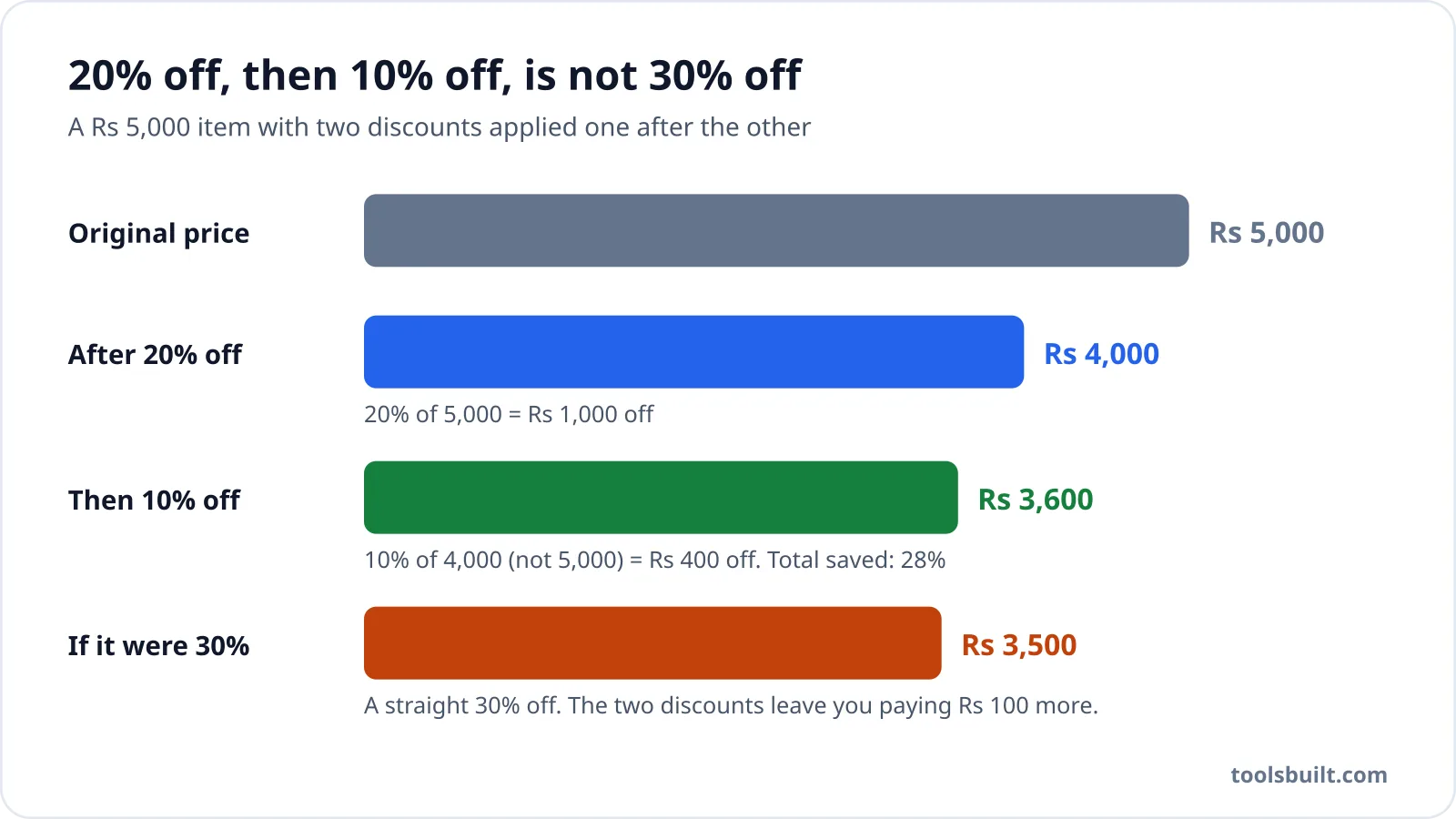
You pay Rs 100 more than a straight 30% off would cost. Not a scandal, but worth knowing when two offers compete. The discount calculator handles stacked discounts and optional sales tax in one go.
How do I calculate percentage increase or decrease?
Subtract the old value from the new value, divide by the old value and multiply by 100: (new − old) ÷ old × 100. If rent goes from Rs 40,000 to Rs 46,000, the change is 6,000 ÷ 40,000 × 100 = 15%. A positive result is an increase and a negative result is a decrease.
The base is the value you started from, which is why an increase and the matching decrease are not equal. If that rent later falls back from Rs 46,000 to Rs 40,000, the change is −6,000 ÷ 46,000 × 100 = −13.04%. Same Rs 6,000, but measured against a bigger starting number.
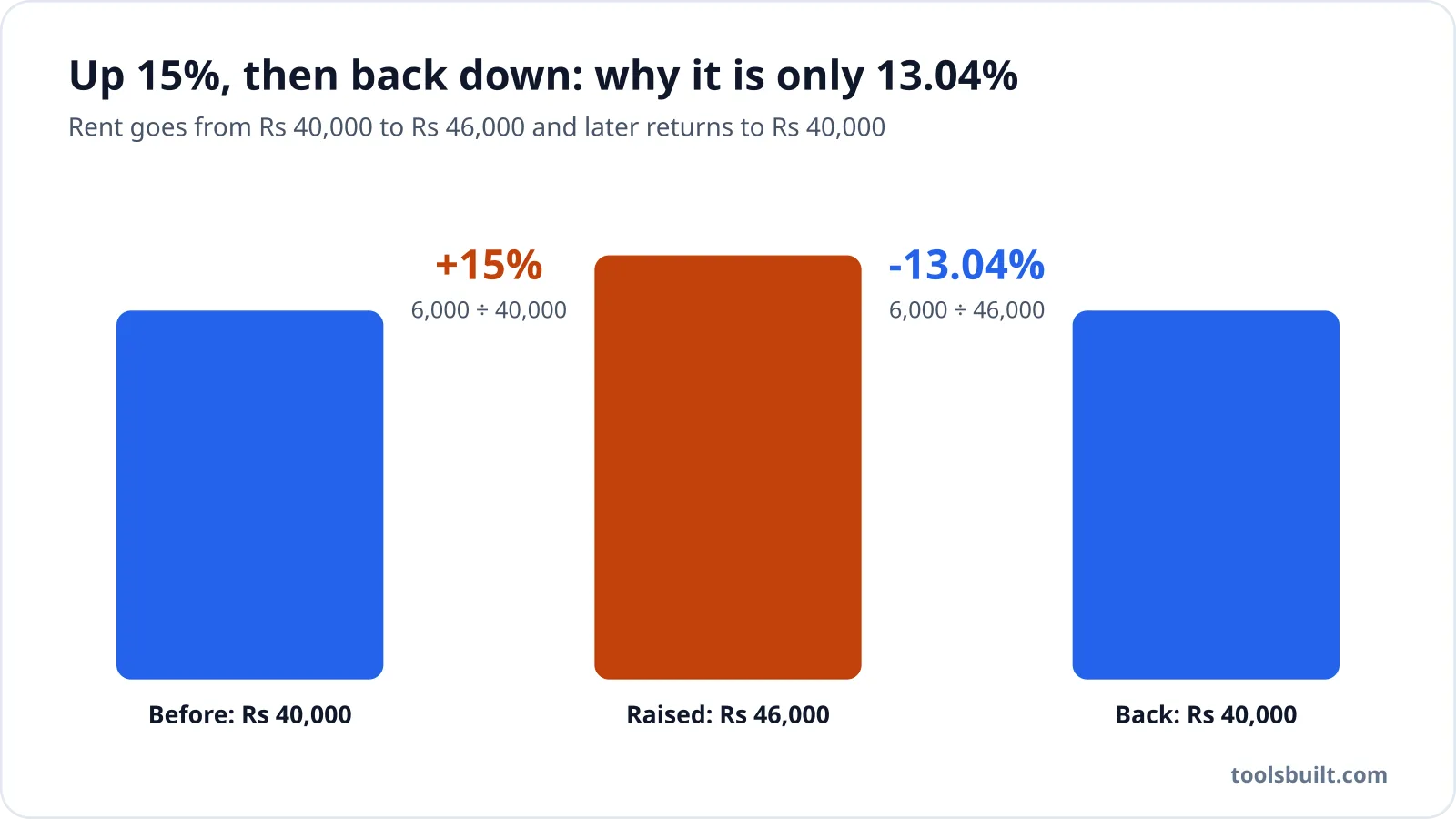
It works the other way too. Put a price up 25% and then down 25%, and you do not get back to where you started. Rs 1,000 becomes Rs 1,250, and 25% off Rs 1,250 is Rs 937.50. That is why "prices rose 25% and then fell 25%" still leaves them lower than before.
The percentage change calculator does increase, decrease and percentage difference, and tells you which base it used.
What is the difference between percent and percentage points?
Percentage points are the simple difference between two percentages. Percent change measures that difference against the starting percentage. If a school's pass rate goes from 40% to 50%, it rose by 10 percentage points, but by 25% in relative terms, because 10 ÷ 40 × 100 = 25%.
Both statements are true. They answer different questions, and mixing them up is how a modest change gets reported as a dramatic one, or the reverse. When you read "up 10%", it is fair to ask: 10 points, or 10 percent of the old figure? Math is Fun has a clear short page on percentage points if you want more examples.
The same distinction shows up with interest rates. A loan rate moving from 16% to 18% is a rise of 2 percentage points, which is a 12.5% increase in the rate itself. Our guide on how to calculate loan EMI in Pakistan shows what those 2 points do to a 15-year home loan.
What mistakes give wrong percentage answers?
The four below all come from dividing by the wrong number: averaging percentages with different totals, adding stacked discounts together, reversing a discount by adding the percentage back, and confusing profit on cost with profit on price. Each one below has the wrong working next to the right one, so you can spot it in your own sums.
Averaging percentages that have different totals
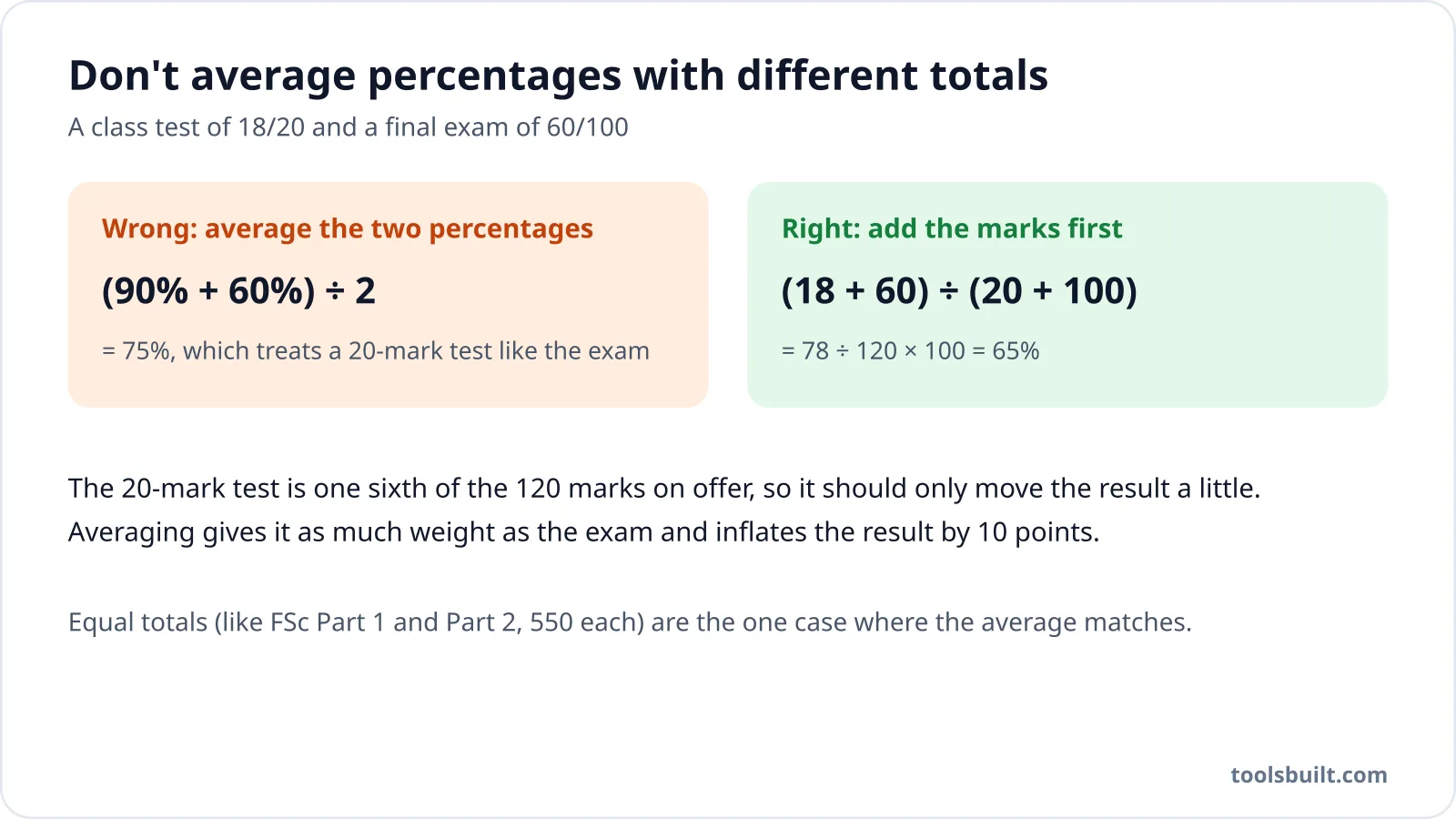
A student gets 18 out of 20 in a class test (90%) and 60 out of 100 in the exam (60%).
- Wrong: (90% + 60%) ÷ 2 = 75%.
- Right: add the marks first. (18 + 60) ÷ (20 + 100) = 78 ÷ 120 × 100 = 65%.
Reversing a discount by adding the percentage back
You paid Rs 2,040 after a 15% discount and want the original price.
- Wrong: 2,040 + 15% of 2,040 = 2,040 × 1.15 = Rs 2,346.
- Right: 2,040 ÷ 0.85 = Rs 2,400. The 15% was taken from the original price, so you divide by what was left, 85%.
The same trap catches people removing sales tax from a receipt. Take a tax-inclusive price apart by dividing, not by subtracting the tax rate from the total.
Mixing up profit margin and markup
A shopkeeper buys stock for Rs 1,600 and sells it for Rs 2,400. The profit is Rs 800.
- As a percentage of cost (markup): 800 ÷ 1,600 × 100 = 50%.
- As a percentage of the selling price (margin): 800 ÷ 2,400 × 100 = 33.33%.
Neither is wrong, but they are different numbers. If a supplier says "keep a 50% margin" and you apply a 50% markup instead, your margin is a third, not a half. The profit margin calculator shows both at once.
Adding stacked discounts together
Covered above: 20% then 10% off is 28%, not 30%. Multiply the "what is left" factors instead: 0.80 × 0.90 = 0.72, so you pay 72% and save 28%.
Which calculator should I use?
Use the one that matches your question. The percentage calculator for "X% of Y" and "what percent is X of Y", the marks calculator for results, the discount calculator for prices and offers, and the percentage change calculator when something went up or down. Each shows the formula and the working, so you can check it against your own sums.
- Percentage calculator: X% of a number, what percent one number is of another, and reverse percentages.
- Marks percentage calculator: obtained and total marks, subject by subject if you like.
- Discount calculator: sale price, money saved and stacked discounts.
- Percentage change calculator: increase, decrease and percentage difference.
Math is Fun's page on percentage change covers the same formula with more school-style practice. For money that grows or shrinks every month, percentages compound, and the loan EMI guide picks up from there.