Your GPA is your grade points divided by your credit hours for one semester. Your CGPA is the same calculation across every semester so far. In both, a course with more credit hours counts for more, so you cannot simply average your grades or your semester GPAs. This guide works through one student's results from the transcript to the GPA they need next.
Key takeaways
- GPA = Σ(grade points × credit hours) ÷ Σ(credit hours) for one semester.
- CGPA = all grade points so far ÷ all credit hours so far.
- Never average semester GPAs unless every semester has the same credit hours.
- The more credit hours you have done, the harder it is to move your CGPA.
- CGPA ÷ 4 × 100 is only an estimate. Your university's own conversion is the official one.
It is tempting to look at the CGPA only when the result comes out and work backwards from the number on the portal. It is easier the other way round. Once you see how the grade points add up, you can check your result, spot a mistake and plan what the next semester has to look like.
How do you calculate your semester GPA?
Give each course its grade points from the scale, multiply by the course's credit hours, add the results and divide by the total credit hours. A semester of A- (3 credits), A (4), B+ (3), B (3) and a 1-credit lab with an A gives 50.0 grade points over 14 credit hours: 50.0 ÷ 14 = 3.57.
| Course | Grade | Grade points | Credit hours | Grade points × credit hours |
|---|---|---|---|---|
| Calculus | A- | 3.7 | 3 | 11.1 |
| Programming | A | 4.0 | 4 | 16.0 |
| Physics | B+ | 3.3 | 3 | 9.9 |
| English | B | 3.0 | 3 | 9.0 |
| Physics Lab | A | 4.0 | 1 | 4.0 |
| Total | 14 | 50.0 |
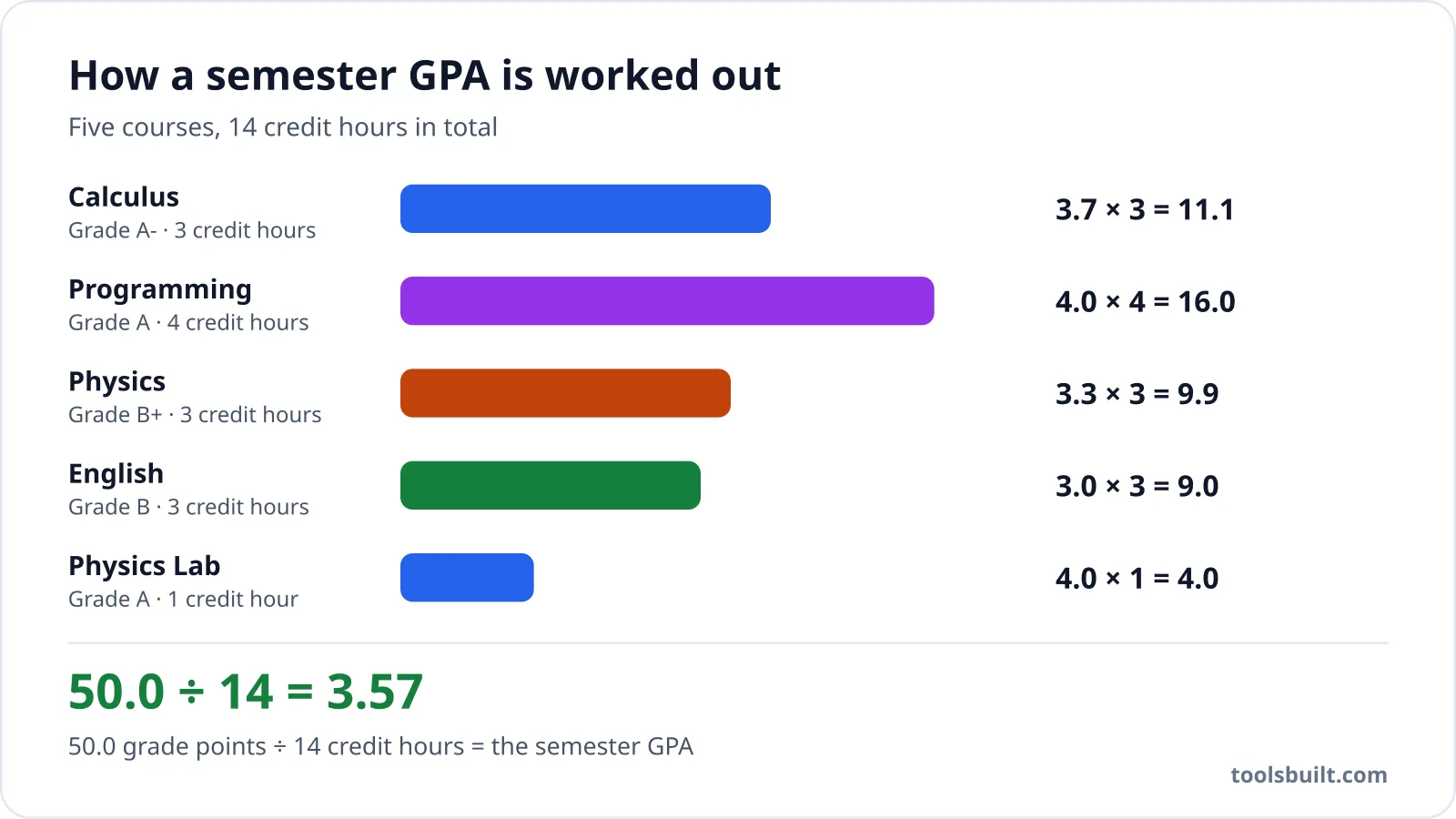
The plain average of the five grade points is 3.6, a little higher than the real 3.57. The difference is small here, but it comes from a real effect: the 1-credit lab counts for a quarter as much as a 4-credit course, and the plain average treats them the same.
The GPA calculator does this for you. Pick each course's grade, enter its credit hours, and it shows the grade points and the GPA.
Which grade points does each letter grade get?
On the common 4.0 scale with plus and minus grades, A and A+ are 4.0, A- is 3.7, B+ 3.3, B 3.0, B- 2.7, C+ 2.3, C 2.0, C- 1.7, D+ 1.3, D 1.0, D- 0.7 and F 0.0. This is the scale our GPA calculator uses, but your university's handbook decides the scale that counts for you.
| Grade | Points | Grade | Points |
|---|---|---|---|
| A+ / A | 4.0 | C | 2.0 |
| A- | 3.7 | C- | 1.7 |
| B+ | 3.3 | D+ | 1.3 |
| B | 3.0 | D | 1.0 |
| B- | 2.7 | D- | 0.7 |
| C+ | 2.3 | F | 0.0 |
Some universities use plain A, B, C, D and F without plus and minus, and many print the marks range for each grade on the result card. The method stays the same: only the points per grade change. If your result card already shows grade points per course, use those and skip the table.
How do you calculate your CGPA across semesters?
Add the grade points from every semester and divide by every credit hour you have taken. If your CGPA was 2.80 after 60 credit hours, those are 2.80 × 60 = 168.0 grade points. Add this semester's 50.0 points over 14 credit hours: (168.0 + 50.0) ÷ (60 + 14) = 218.0 ÷ 74 = 2.95.
You do not need your old transcript for this. Your current CGPA and the credit hours you have completed are enough, because CGPA × credit hours gives back the total grade points.
| Credit hours | Grade points | |
|---|---|---|
| Before this semester (CGPA 2.80) | 60 | 2.80 × 60 = 168.0 |
| This semester (GPA 3.57) | 14 | 50.0 |
| New CGPA | 74 | 218.0 ÷ 74 = 2.95 |
Why is my CGPA not the average of my semester GPAs?
Because semesters with more credit hours count for more. Averaging 2.80 and 3.57 gives 3.19, but the 2.80 covers 60 credit hours and the 3.57 only 14. Weighted by credit hours, the CGPA is 2.95. A plain average of GPAs is only right when every semester has the same credit hours.
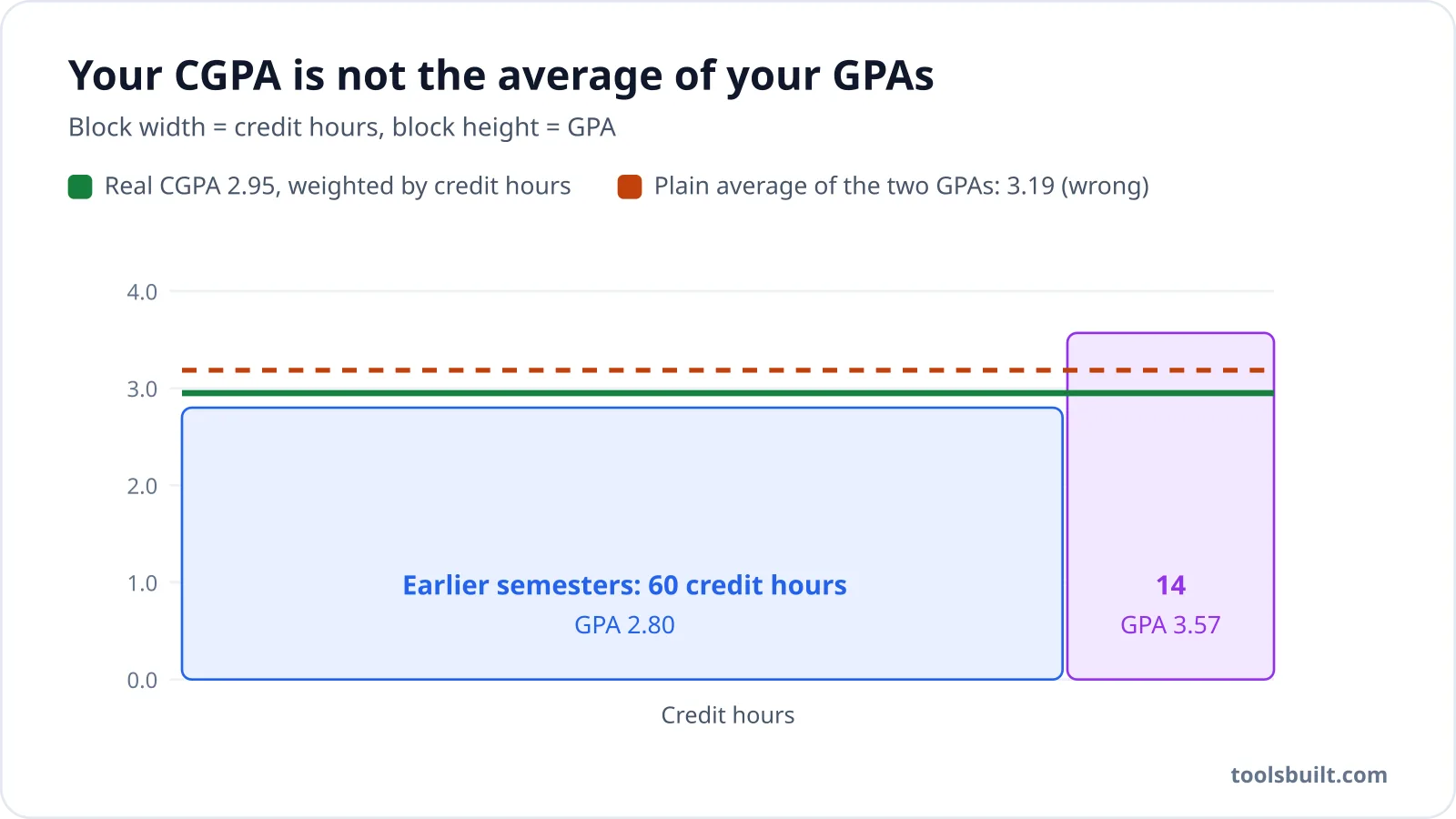
This is also why a good semester late in a degree moves the CGPA less than you hope. Our student's 3.57 is well above their 2.80, yet it lifts the CGPA by only 0.15. The same 3.57 in their second semester would have moved it much more.
What GPA do you need next semester to reach a target CGPA?
Needed GPA = (target CGPA × total credit hours after the semester − grade points you already have) ÷ credit hours next semester. Before this semester our student had 168.0 points over 60 credit hours. To finish the 14-credit semester with a 3.00 CGPA they needed (3.00 × 74 − 168.0) ÷ 14 = 54.0 ÷ 14 = 3.86.
| Target CGPA after the semester | Grade points needed in total | Points needed this semester | GPA needed this semester |
|---|---|---|---|
| 2.85 | 210.9 | 42.9 | 3.06 |
| 2.90 | 214.6 | 46.6 | 3.33 |
| 2.95 | 218.3 | 50.3 | 3.59 |
| 3.00 | 222.0 | 54.0 | 3.86 |
| 3.05 | 225.7 | 57.7 | 4.12, not possible on a 4.0 scale |
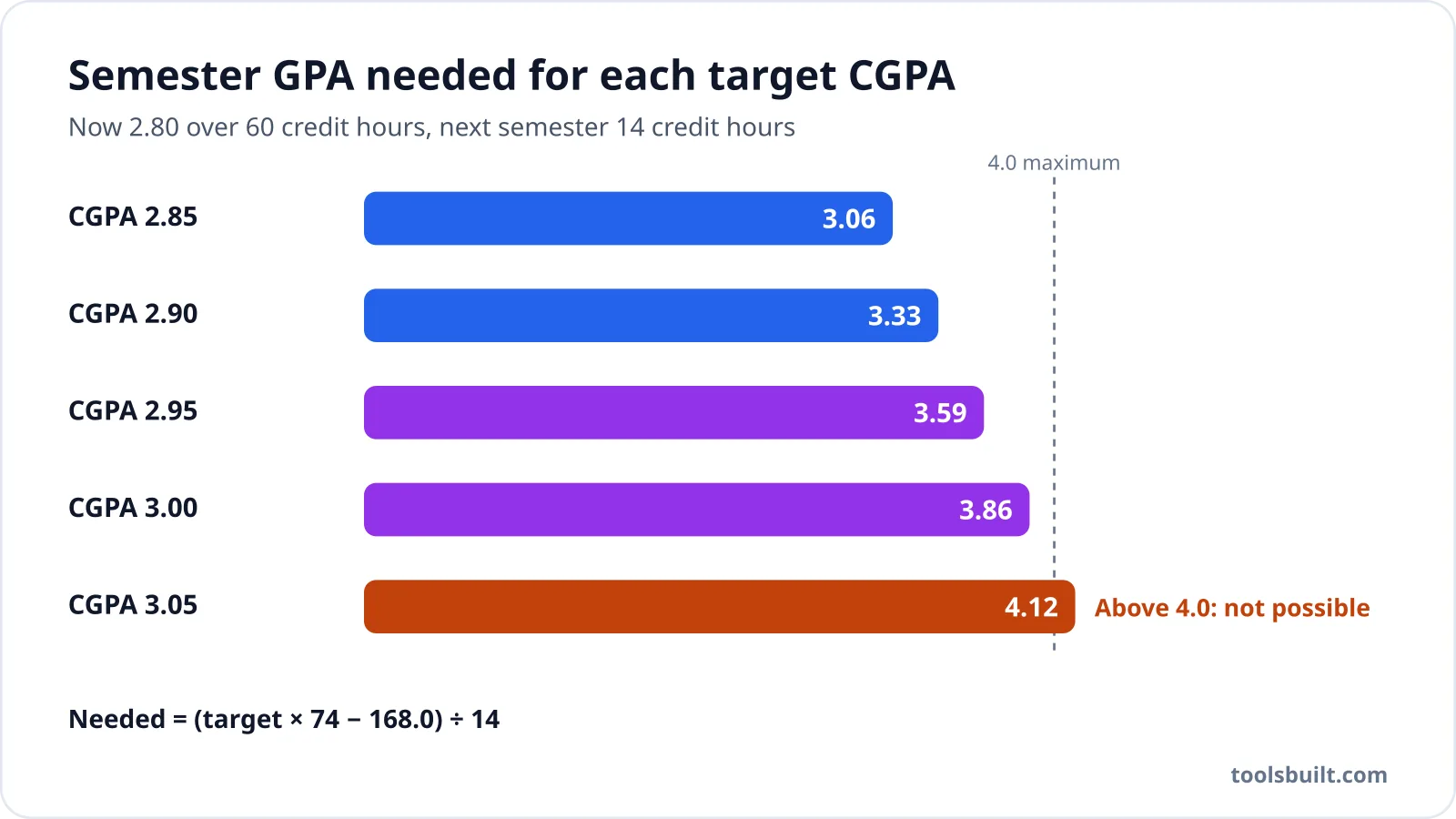
Our student actually got a 3.57, just short of the 3.59 needed for a 2.95, which is why the CGPA came out at 2.95 after rounding but 2.946 before it. If a target needs more than 4.0, it cannot be reached in one semester. Spread it over two semesters, or check whether a repeated course replaces the old grade at your university, which changes the calculation.
How do you convert CGPA to a percentage?
The simple proportion is CGPA ÷ 4 × 100, so a 2.95 CGPA on a 4.0 scale is 73.75%. It is only an estimate. HEC does not publish one conversion formula for every university in Pakistan. If your transcript or your university states its own formula, that one is official for your degree.
The CGPA to percentage calculator does the simple proportion on 4, 5 and 10-point scales, and also takes a custom formula, so you can enter the one printed on your transcript. Use the percentage your university gives you on job and scholarship forms, not a number from a website, including this one.
What mistakes give a wrong GPA or CGPA?
Four mistakes cause most wrong results: averaging grades without credit hours, averaging semester GPAs, using a different grade scale from your university's, and rounding the CGPA before doing more maths with it. Each one can move the result by a tenth or more, which matters near a scholarship or probation cut-off.
- Ignoring credit hours. A 4-credit course counts four times as much as a 1-credit lab. Always multiply by credit hours first.
- Averaging semester GPAs. As shown above, 2.80 and 3.57 average to 3.19, but the real CGPA is 2.95.
- Using the wrong scale. If your university gives B+ 3.5 instead of 3.3, every B+ changes your GPA. Use the points in your own handbook.
- Rounding too early. Our student's CGPA is 2.946 before rounding. Multiplying the rounded 2.95 by 74 gives 218.3 points instead of the real 218.0. Keep the full number until the last step, or work from total grade points.
How can you check your GPA quickly?
Open the GPA calculator, add each course with its grade and credit hours, and it shows your semester GPA. Add your previous CGPA and credit hours to get the new CGPA. The calculation runs in your browser and there is no sign-up.
If your course has a final exam still to come, the guide on how to calculate your grade shows how to work out the score you need in one course. When your result card and your own calculation disagree, ask your department how they count repeated courses and labs. It is usually one of those two.
— Abu Umair